
In fact, when you think you’re getting a hang of things, you realize that you may be lagging behind. So, the only way to thrive in an ever-changing environment is to evolve and adapt.
SEO 2018 has been a year of search engines striving to improve the quality of search results. So far we’ve seen an onward march of mobile domination, personalization in search and algorithmic changes to name a few.
As 2019 approaches, I’ve rounded up a list of SEO industry trends that you ought to look out for. With these prominent trends that are gaining momentum in mind, you can always keep one eye on the horizon to see what lies ahead.
If you want to up your search optimization game, improve rankings and get more organic traffic, then this is the guide to SEO in 2019 you’ll need.
Trend #1: Word Vector
Language is beautiful.
But, it is also hard, especially when it comes to describing abstract linear concepts.
This is where math is really useful. In the field of Natural Language Processing (NLP), in which computers are taught to understand and generate words in order to communicate more humanely.
Discussions on terms like NLP, Artificial Intelligence (AI) and Machine Learning (ML) are no stranger to the Internet community these days. All three go hand in hand because a computer has to learn in order to process language.
That happens when the computer is provided a training set of data to the models or algorithms in use and is refined until the model generally does what you want it to do.
In 2013, a super complex algorithm that smart data scientists from Google created using this framework formed what is called, Word Vector or Word Embedding today.
This is an exciting field because it’s still a baby; its capabilities and influence are only going to grow in the near future. If you’ve noticed, it’s pretty clear that Google is betting heavily on machine learning.
2019 is a year we’ll see more breakthroughs done by computers.
Moving on, this glossary will introduce key concepts and terms in a way that (hopefully) even our grandmothers can understand.
Let’s tackle this part by part.
Google’s AI Model: Word Vector
“Google is living a few years in the future and sends the rest of us messages,”
Doug Cutting, Google Hadoop founder
Word Vector is a model pre-trained by Google.
Yes, the mighty search engine we are all fighting to get a spot on.
It is an algorithm that helps Google learn about the relationships between words, based on examples of actual language usage.
These vector models map semantically similar phrases to nearby points based on equivalence, similarities or relatedness of ideas and language.
A simple way to investigate the phrases is to find the closest words for a user-specified word. The distance between words serves the purpose.
For example, if you enter “France”, distance will display the most similar words and their distances to “France”, which should look like:
Believe it or not, the model can leverage very little of what it has learn about “France” when it is processing data about “Spain” (such as they are both countries, Europe, etc.)
At present, word vectors are considered to be among a number of successful applications of unsupervised learning.
The Birth of Word2Vec
Word2vec is one of the most popular technique to learn word vector using shallow neural network. It was developed by Tomas Mikolov in 2013 at Google.
He was the one who really brought word vector to the fore through the creation of Word2vec, a toolkit enabling the training and use of pre-trained vectors.
The easiest way to think about Word2Vec is that it figures out how to place words on a “chart” in such a way that their location is determined by their meaning.
To put it simply, two words that have close proximity in the vector space tend to share a common context; whereas two words that are far from each other are regarded as not contextually related.
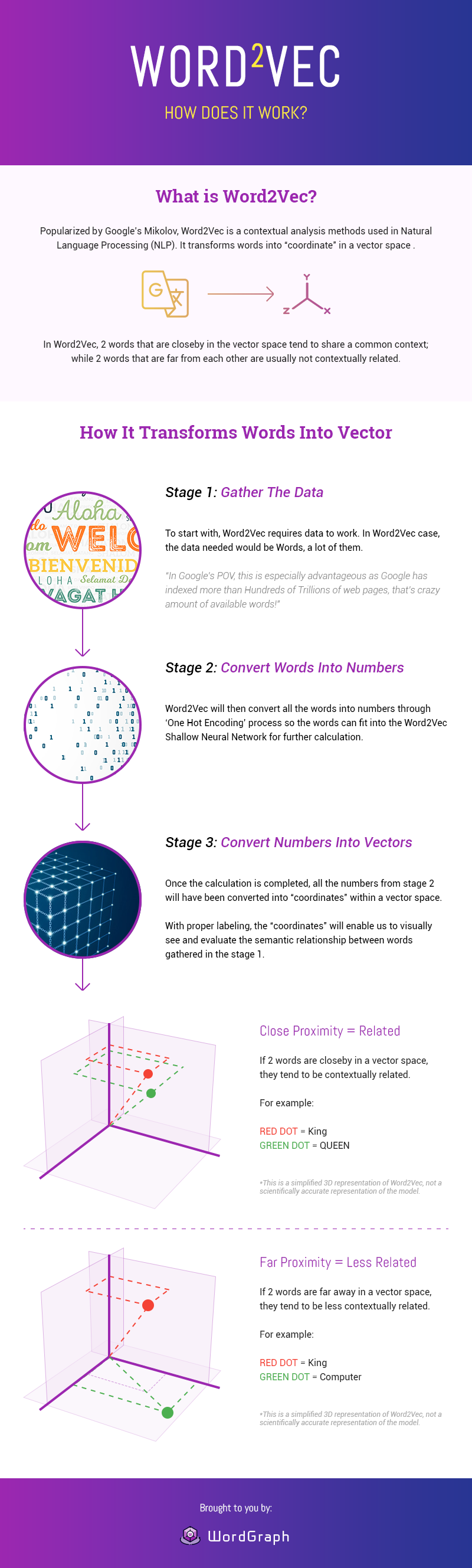
In a research done by Tomas Mikolov and his team, it is understood that when the word vectors are well-trained, it is possible to find accurate answers and improve many future NLP applications.
In a nutshell, this model is very fast and easy to use. It requires only plain text, which we have a lot.
For best performances, it is important to continue training (fine-tuning) them as it feeds on data. The bigger the data, the more accuracy you’ll get.
Read more on https://seopressor.com/blog/seo-in-2019-6-trends-to-watch-seopressor/

No comments:
Post a Comment